
13 April 2021
By Lucas Quidera
I am pro-life because I believe in human equality.
We all should be deeply concerned about getting this issue right. History is replete with examples of the horrendous consequences that can follow when we fail to affirm the dignity of all human beings. We saw that when slavery was practiced. We saw that during the holocaust. We saw that when Australia treated the aboriginals as sub-humans and killed them. While we are shocked by such atrocities today, at the time there were many who thought this evil was perfectly acceptable. We don’t want to repeat their mistakes.

Now, what do I mean by human equality? I mean every human being has fundamental moral value and is entitled to certain basic human rights—because they are human beings—and first among these is the Right to Life.
If this belief is true it must be acted upon. A government that does not recognize and protect these fundamental rights for all their citizens, in effect denies that they have these rights.
This is expressed in the American Declaration:
“We hold these truths to be self-evident: That all men are created equal; that they are endowed by their Creator with certain unalienable rights; that among these are life, liberty, and the pursuit of happiness; that, to secure these rights, governments are instituted among men.”
If all humans are equal, then the unborn also have the inalienable right to life, if they are shown to be humans.
So are they human beings?
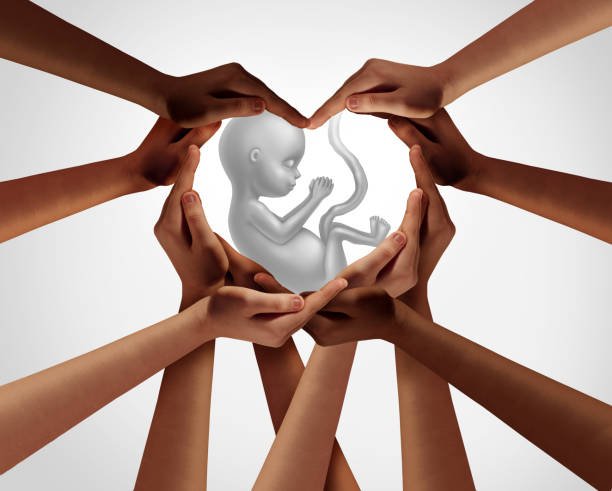
It would be wrong to ignore this question. This is the central issue of the abortion debate—which is a matter of life and death. Fortunately, we don’t need to resort to speculative opinions. Science can answer this question for us. Many people (non-scientists) think there’s no way of knowing when life begins, and yet nearly all biologists (95%)[1] have to come to just the opposite conclusion. Based on decades of scientific research, we know that human life does begin at conception.
Leading embryology textbooks affirm that the unborn are distinct, living, and whole human beings from the time of their conception as a zygote (the successful result of fertilization.)
“The development of a human being begins with fertilization, a process by which two highly specialized cells, the spermatozoon from the male and the oocyte from the female, unite to give rise to a new organism, the zygote.”[2]
“Although life is a continuous process, fertilization is a critical landmark because, under ordinary circumstances, a new, genetically distinct human organism is thereby formed… The combination of 23 chromosomes present in each pronucleus results in 46 chromosomes in the zygote. Thus the diploid number is restored and the embryonic genome is formed. The embryo now exists as a genetic unity.” [3]
At conception, your entire makeup as a human is set, and from that point, you internally direct your development according to your own genetic blueprint. The zygote is not a “pre-human.” It is a human at an earlier stage of development. You are the same organism as your zygote self. You are biologically the same type of being now as you were when you were a zygote.
Given the scientific consensus on this matter and the lack of contrary evidence, it will not do for our opponents to dismiss this as “religious dogma.” The evidence stares them in the face. It is irrational to deny it.
Abortion kills innocent human beings. But since the unborn are human beings with equal moral status, you can’t kill the unborn without sufficient justification, just as is the case with killing any other human being. And since it is morally unjustifiable to intentionally kill innocent human beings, abortion is wrong. That is why I am Pro-Life.

I reject the “pro-choice” position because it is inconsistent with human equality. Pro-choicers deny it either in principle or in practice.
Just look at some of the arguments pro-choicers use to justify abortion. “The unborn are not self-conscious.” “They aren’t sentient.” “They don’t ‘look’ human.” “They aren’t viable.” “They are unwanted.” “They are economically burdensome.” “They might cause emotional stress” Etc. But this has nothing to do a human being’s moral value.
In order to avoid the conclusion that abortion violates the unborn human’s right life, or the conclusion that these humans don’t have equal moral status with the rest of us, the burden of proof lies on the pro-choicer or denier of human equality to show that there is a morally relevant difference between the born and the unborn that would justify killing the latter. Although there have been many such arguments used against the moral status of the unborn, we may categorize them as follows.
As Stephen Schwarz has pointed out, there are only four major differences between born humans and unborn humans. They are all morally irrelevant.
1. Their Size.
This is true, but why should size be considered value-giving in the first place? If size makes the difference, then killing a Sumo wrestler is more wrong than killing the average human being. But this is nonsense and undermines equal moral rights.
2. Their Level of development.
Various arguments of this sort assume the unborn must reach a certain level of development to be considered fully human. The unborn are less developed than we are, but this makes no difference ethically speaking. New-borns are less developed than one-year-olds; one-year-olds are less developed than five-year-olds; five-year-olds are less developed than fifty-year-olds, and so on. But this is no reason to deny their moral status. This view would imply that people’s moral status increases as they develop. (After all, humans take years to develop fully). But adults don’t have a greater right to live than children do. Once again, we find a complete contradiction of human equality. And regardless of whatever (specific) arbitrary criteria they assume, they all would imply a gradation of rights because development, by its very nature, does not occur instantly.
3. Their Environment (location).
But where you are has no bearing on your moral status. Sometimes fetal surgeries are performed outside the womb. By the pro-choice logic, the child would get the right to life during the surgery and then lose it after it ends. This is silly. No view of human equality or moral value can afford to be based on something as arbitrary as to where you are located.
4. Their Degree of dependency.
The unborn depend on their mother for their survival. But why should one’s dependence on another human being mean we can kill that human being? This is counter-intuitive. We should rather protect the vulnerable, not violate their rights. Conjoined twins, for instance, are dependent on one another, but, surely, killing one of them is immoral.
All of these distinctions are arbitrary and irrelevant, fail to justify abortion, and are contrary to human equality.
So the question is, Upon what basis can we affirm human equality?
Intrinsic value is a necessary condition for human equality. If humans are valuable only to the extent that they are valued by society, then even a holocaust may be justified. If humans are valuable only to the extent that they serve certain ends, then, of course, slavery may be justified. If you deny intrinsic moral worth, you are going to have a hard time trying to account for human dignity and equality in ethics.
But what makes humans valuable?
Does it depend on some acquired property or capacity, such as self-awareness or sentience, that one may gain and lose during one’s lifetime, as many pro-choicers argue? Such a view cannot account for human equality or human worth. If that view were true, human equality would come in degrees (since these aren’t gained all at once), with some people being more valuable than others, and in turn, have a greater right to life. This is to say, their view implies that all humans cannot be equal. Even further, all the various criteria they have suggested to us are arbitrary, and they can’t explain why these are value-giving properties in the first place.
These criteria are also conflicting. You cannot adopt all of them. You have to choose between them. You cannot choose both brain waves and viability, or self-awareness and sentience, for example, since these properties or capacities are not all acquired at the same time. So you must make an arbitrary choice between them. (And the fact that they have suggested so many of them, without coming to any agreement as to which is the right one, is an illustration of their baselessness.) But it is a mistake to even reason in this way—to hold that properties or functions are the basis of human dignity. After all, sentience, for example, is not valuable in the abstract. It’s humans–who usually (but not always) possess that property that are valuable.)
The Pro-choice position cannot account for human equality. But the pro-life position can.
The pro-lifer holds that human beings are intrinsically valuable–and that they are valuable, not because they exercise some capacity to do this or that, but rather in virtue of what they are—the kind of thing that they are. Human beings are valuable by nature. And the unborn are human beings, so they have just as much moral value as the rest of us.
So what makes us equal? Upon what basis can we affirm the equal moral worth and moral rights of all human beings? Only based on something we all have in common (posses equally)–our human nature. So if the unborn are human beings, then they too are full-fledged members of the human community and share our human dignity, and thus possess the same moral status as the rest of us. And that means it is wrong to intentionally kill them.
But suppose that one accepts this view of human equality, can one still be pro-choice? On the contrary, if one accepts this position, one will be logically led to the pro-life position and reject the abortion-choice position.
Abortion-choicers may try to turn things around and say that if we believe in human equality, then we should be for abortion-choice because women have the right to control their bodies, but this argument is mistaken. Pro-lifers grant that a woman has the right to control her body, but deny that this justifies abortion because the right to control one’s body (or bodily autonomy) is not absolute. You don’t have the right to rape another person because you have the right to control your body. You cannot exercise your rights in a way that unjustly violates another’s rights. That would be contradictory. It would be to say you have the right to do what is wrong, to commit injustice.
So, if abortion unjustly takes the life of an innocent human being of moral value, then abortion is wrong and impermissible.
I am pro-life because I believe that all human beings are fundamentally equal. The burden of proof is on the one who denies this. And the abortion-choicers have failed to show that there is any non-arbitrary and morally relevant distinction between the born and the pre-born human being that would make it acceptable to kill the pre-born, but not other innocent people. The pro-life position intuitively makes sense as it is simply asking that we apply the same principles of ethics to the pre-born human beings as to the rest of us, and to treat them as one of us—members of the human family. The pro-choice position cannot account for human equality without adopting our view, but if they do, they cannot continue to deny the right to life to the pre-born. Hence, whoever wishes to consistently maintain human equality must adopt the pro-life position.
So, to sum it up in one sentence:
I am pro-life because I believe in human equality.
Protecting the Defenseless – The Lifeguard Initiative
[1] Biologists’ Consensus on ‘When Life Begins’ – (PDF) -Steven Andrew Jacobs
[2] Langman, Jan. Medical Embryology. 3rd edition. Baltimore: Williams and Wilkins, 1975, p. 3
[3] O’Rahilly, Ronan and Muller, Fabiola. Human Embryology & Teratology. 2nd edition. New York: Wiley-Liss, 1996, pp. 8, 29.